


Why Choose Direct Farm Beef Delivery: A 2026 Guide

Table of Contents
Why Direct Farm Beef Delivery Is Gaining Ground in 2026
How to Buy Beef Directly from a Farm: What the Process Looks Like
Choosing Your Cuts and Quantity
What to Ask Before You Order
Farm Beef vs Grocery Store Beef: Quality, Cost, and Transparency
The Real Cost Comparison
What You Can Verify That You Cannot at a Supermarket
Questions That Separate a Real Farm from a Label
Bulk Beef Delivery: Whole, Half, or Custom Boxes
How to Store Delivered Beef: Freezer Space and Portioning
Delivery Logistics and Cold-Chain Safety
How Farms Actually Ship
Delivery Areas, Schedules, and Receiving
What to Do When Something Goes Wrong
How Direct Farm Beef Delivery Builds Local Food Communities
Frequently Asked Questions
Last Updated: October 14, 2026
Why Direct Farm Beef Delivery Is Gaining Ground in 2026
Direct farm beef delivery is a service where a farm sells beef directly to households and delivers it to their door, cutting out the grocery store entirely.
Families across Alberta are rethinking where their beef comes from.
Below, we break down the buying process, cold-chain logistics, and how to verify the claims a farm makes. The five sections that follow cover everything you need before your first order.
How to Buy Beef Directly from a Farm: What the Process Looks Like
Buying beef directly from a farm follows a simple path: choose your cuts and quantity, confirm the details, and arrange delivery. Most farms list available cuts and box sizes online, so you can order without a phone call.
Choosing Your Cuts and Quantity
Start with how your household actually eats. Ground beef, steaks, roasts, and stewing cuts all come from the same animal, so a mixed box usually gives better value than ordering one cut in bulk.
Think in meals, not kilograms. If you cook beef three times a week, a mixed box sized for roughly a month of meals is a sensible starting point.
What to Ask Before You Order
Ask these questions before you commit:
How was the animal raised, and can you show me documentation?
Is the beef grass-fed, pasture-raised, or grain-finished?
What cuts are in this box, and can I swap any out?
A farm that answers these clearly, and in writing, is a farm worth buying from. Vague answers are a warning sign.
Farm Beef vs Grocery Store Beef: Quality, Cost, and Transparency
Farm beef and grocery store beef differ most in traceability. Supermarket beef is pooled from many sources, so the pack you buy rarely traces back to a single animal or farm. Direct farm beef comes from one operation you can name, visit, and question. That difference shapes everything else, including how the price is built.
The Real Cost Comparison
Per-kilogram pricing is where the comparison gets interesting, and where most shoppers stop too early.
The honest answer is that pricing depends on the cuts you choose, the quantity you order, and current market conditions. We do not publish fixed prices because they change with the season and the animal.
A direct farm order usually has four pricing components:
Cut price per kilogram. This is the headline number, and it varies sharply by cut. Ground beef and stewing cuts sit at the low end; prime steaks and tenderloin sit at the high end. A mixed box blends the two.
Processing and butchering fees. When you buy a whole or half animal, the abattoir charges a kill and cut-and-wrap fee, often billed separately from the farm's price. Ask whether the quoted price is "hanging weight" or "take-home weight", the difference is significant, because hanging weight includes bone and trim you do not take home.
Delivery charges. Some farms include delivery within a set radius and add a surcharge beyond it. Others charge a flat fee per order. Ask before you order, not after.
To compare fairly, convert everything to cost per meal, not cost per kilogram on a single cut.
What You Can Verify That You Cannot at a Supermarket
At a supermarket, you can verify a label. At a farm, you can verify a practice. That difference matters if animal welfare, hormone use, or feed quality is why you are shopping this way in the first place.
Look for an Alberta-inspected facility and licensed food handling. The Canadian Food Inspection Agency guidance on meat and poultry sets the baseline for what can legally be sold and how it must be labeled.
Pro Tip Ask for the name of the processing facility, not just the farm. A farm that names its abattoir and its inspection status is telling you it has nothing to hide. A farm that dodges the question usually has a reason.
Questions That Separate a Real Farm from a Label
A short list of questions does most of the verification work for you:
What was the animal fed, and was it finished on grass or grain?
Was it raised on this farm, or bought in from elsewhere and resold?
Which abattoir processed it, and is that facility provincially or federally inspected?
Are antibiotics used routinely, or only to treat a sick animal under veterinary direction?
Vague answers are a warning sign. Clear, written answers are the whole point of buying direct.
Bulk Beef Delivery: Whole, Half, or Custom Boxes
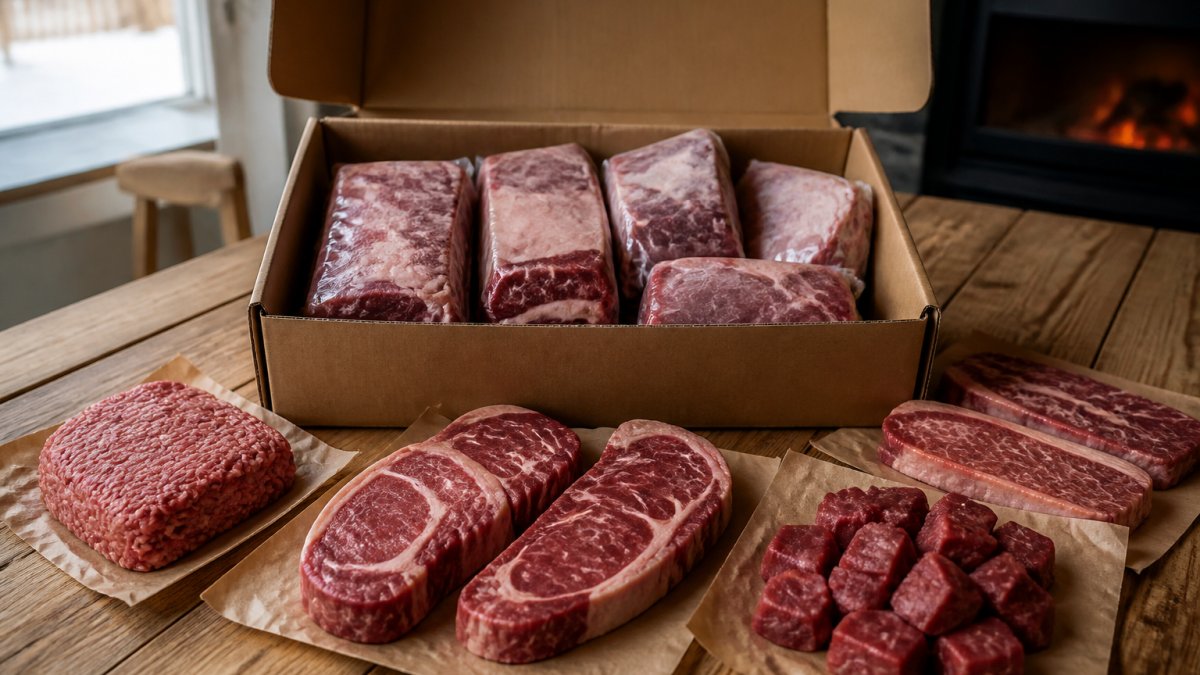
Bulk beef delivery comes in three main formats: a whole carcass, a half carcass, or a custom box of selected cuts.
A whole or half animal gives a wide cut selection, but it demands serious freezer space and a plan for using every cut, including the ones you do not love.
Option | Best For | Freezer Space Needed | Cut Flexibility |
Whole carcass | Large families, shared purchases | Very high | Full control |
Half carcass | Households of 4+ | High | Broad selection |
Custom box | Couples, small families, condos | Moderate | Choose your cuts |
If you have never ordered bulk beef before, start with a custom box. You learn how your household uses the cuts before you commit to a larger share.
How to Store Delivered Beef: Freezer Space and Portioning
Storing delivered beef well starts before it arrives. Clear and organize your freezer first, then portion the delivery into meal-sized packages the day it lands.

A few habits keep quality high:
Keep the beef frozen until you are ready to use it, and thaw in the fridge, never on the counter.
Portion into meal-sized packages so you thaw only what you need.
Label everything with the cut and the date.
Rotate stock so older packages get used first.
Vacuum-sealed packaging holds quality longer than loose wrapping, which is why most farms ship this way.
Delivery Logistics and Cold-Chain Safety
Cold-chain safety is the part of direct farm beef delivery that separates a professional operation from a hobby farm with a cooler. The beef must stay at a safe frozen temperature from the farm to your door, and the way a farm handles that tells you how seriously it takes the product.
How Farms Actually Ship
Most direct farm beef moves in one of three ways:
Insulated box with gel packs or dry ice. The standard for courier-shipped orders. The box is designed to hold frozen temperature for a set window, usually 24 to 48 hours depending on pack-out and weather.
Refrigerated transport. Used for larger bulk orders and regional routes. The beef stays frozen or deeply chilled the whole way.
Personal delivery. The farm drives the order to you. This is the most flexible option, because the driver can coordinate timing and handle the handoff directly.
Ask which method the farm uses before you order, and ask how long the box is rated to hold temperature. That number tells you how much slack you have if you are not home at the drop.
Delivery Areas, Schedules, and Receiving
Delivery logistics vary by farm, so confirm these details up front:
Delivery area. Many farms deliver within a set radius and either decline or surcharge beyond it. If you are outside the core zone, ask whether a pickup point or a combined run is available.
Schedule. Some farms run fixed routes on set days; others book a window with you. Know which one you are getting so you can plan to be home.
Receiving instructions. If you will not be home, ask where the driver will leave the box and whether that spot stays shaded and out of the sun. A box left on a sunny step in July is not the same as one left in a shaded porch cooler.
Contact on the day. Get a phone number or text thread so the driver can reach you if the route runs early or late.
What to Do When Something Goes Wrong
Even good operations have bad days. The cold chain can break, a route can run long, or a box can arrive damaged. What matters is how the farm handles it.
Watch Out Never accept a delivery where the beef has thawed and refrozen. Ice crystals, soft spots, or a warm box mean the cold chain broke. Photograph it and contact the farm before you put it in your freezer.
A few practical steps protect you:
Inspect on arrival. Check the box for damage, feel for cold, and look for signs of thaw.
Photograph anything wrong. Timestamped photos make a claim straightforward.
Contact the farm the same day. Most farms want to make it right and will replace or credit an order that arrived compromised.
Know the policy before you order. Ask what happens if a delivery is late, damaged, or missed. A farm that has a clear answer is a farm that has done this before.
Key Takeaway Cold-chain safety is not a detail, it is the product. A farm that can explain its packaging, its temperature window, and its failure policy in plain language is a farm you can trust with a bulk order.
How Direct Farm Beef Delivery Builds Local Food Communities
Every direct order keeps money in the local food community instead of routing it through distributors and retailers.
Local sourcing also shortens the distance food travels, which reduces the environmental impact of getting beef to your table. The Government of Canada resources on sustainable agriculture outlines how local food systems support rural economies and lower transport emissions.
There is a social side too. When you buy from a farm, you learn the family's name, you hear how the season went, and you become part of a food community rather than an anonymous shopper in an aisle.
Frequently Asked Questions
Is farm-direct beef actually better than store-bought?
Farm-direct beef typically comes from animals raised on pasture with a natural diet, and it is processed in smaller batches. That often means better marbling, more consistent aging, and a shorter time between processing and your freezer. You also get transparency about how the animal was raised. Store-bought beef may be blended from multiple sources, so tracing its origin is harder. The main trade-off is convenience and upfront cost, but for families who care about sourcing and quality, direct farm beef delivery offers a clearer chain from pasture to plate.
How does direct farm beef delivery work?
You choose your cuts and quantity from the farm's website, place your order, and the farm processes and packs your beef, usually vacuum-sealed and frozen. Delivery is scheduled to your door, often in insulated boxes with ice packs or in a refrigerated vehicle. Some farms deliver personally, which means you can ask questions about the animal, the feed, and the processing. Always confirm the delivery window and whether someone needs to be home, or whether the box can stay safely outside until you arrive.
How long does delivered beef last in the freezer?
Vacuum-sealed beef stored at -18°C or colder keeps its best quality for about 9 to 12 months. After that, it is still safe to eat but may lose flavor and texture. Ground beef is best within 3 to 4 months. Label each package with the date you received it so you rotate your stock. If your freezer runs warmer than -18°C, use the beef sooner. A chest freezer holds temperature more steadily than a fridge-freezer, which helps if you are buying bulk beef delivery.
Is buying beef in bulk from a farm more cost-effective?
Buying a whole, half, or quarter animal can be a good option for those with sufficient freezer space. The catch is upfront commitment and freezer space. If you have room for 50 to 100 kilograms of beef, bulk buying can be a convenient way to stock up for months. If you live in a condo with a small freezer, a custom box with fewer kilograms may suit you better. Ask the farm for a clear breakdown of what you get and how it is priced.
Choosing where your family's beef comes from is a real decision, and the grocery store is not the only option. At Pure Alberta Beef, we deliver 100% Canadian, humanely raised, minimally processed beef straight from our family farm to your door, with the transparency you have been looking for. Our beef is AB inspected and handled in a licensed food handling facility, so you know exactly what you are getting. View our products and start your first order today.
View Products
Comments