


Where to Buy Ethical Beef Alberta: A Buyer's Guide

Table of Contents
What Makes Ethical Beef Different
Understanding Alberta Grass-Fed Beef
How to Buy Beef Directly From a Farm
What to Look for in Humanely Raised Beef
Questions to Ask a Beef Farmer Before You Buy
Verifying Ethical Claims and Certifications
Delivery, Storage, and Getting Started
Frequently Asked Questions
Last Updated: October 11, 2026
What Makes Ethical Beef Different
Ethical beef production prioritizes animal welfare, environmental sustainability, and transparent farming practices. The difference between conventional and ethical beef comes down to how cattle are raised, what they eat, and the care they receive throughout their lives.
Ethical beef means cattle graze on pasture rather than spend their entire lives in feedlots, with no routine antibiotics or synthetic hormones, and farmers who can explain their practices.
Humanely raised cattle experience lower stress, move freely, and eat a natural diet, producing meat with higher omega-3 fatty acids, more conjugated linoleic acid, and better mineral density. When you're considering where to buy ethical beef in Alberta, you're choosing animal welfare, environmental impact, and nutritional quality.
Understanding Alberta Grass-Fed Beef
Grass-fed beef comes from cattle that eat grass and forage for most or all of their lives. Alberta's climate and high-quality grasslands support healthy herds without requiring grain supplementation.
Grass-fed and grass-finished are not the same: grass-fed cattle may be finished on grain before slaughter, while grass-finished beef means cattle eat grass from birth to slaughter. This distinction affects nutritional composition and flavor.
When buying Alberta grass-fed beef, ask whether it's grass-finished, as nutrient density and taste differ noticeably between grass-finished and grain-finished beef.
How to Buy Beef Directly From a Farm
Direct-to-consumer beef sales bypass the middleman, offering a fresher product and complete transparency about how cattle were raised.

Most Alberta farms offer individual cuts or bulk purchases (quarter or half beef). Bulk purchases require freezer space.
Visit the farm's website or contact them directly. Most farms require 2-4 weeks' advance notice for slaughter and processing. Payment methods vary by farm.
What to Look for in Humanely Raised Beef
Humanely raised beef comes from cattle with low stress and space to move naturally. Look for farms that describe grazing practices in detail; specific information is a green flag, vague language a red flag.
Rotational grazing, where cattle move between pastures regularly, prevents overgrazing, aids land recovery, and improves animal welfare and soil health.
Ask the farmer directly about antibiotic and hormone policies. Ethical producers avoid routine antibiotics, using them only when an animal is sick, and avoid synthetic growth hormones.
Smaller herds typically allow better individual animal care and observation, though larger farms can be ethical too.
Questions to Ask a Beef Farmer Before You Buy
Before placing an order for where to buy ethical beef in Alberta, ask these specific questions to verify practices align with your values.
Ask about grazing practices: How much time on pasture? Do they rotate between areas? What do cattle eat in winter? These answers reveal whether the operation is genuinely pasture-based.
Ask what cattle eat besides grass and whether they receive grains or supplements. Farms committed to grass-finished beef should have straightforward answers about minimal grain use.
Ask how the farm handles sick animals, whether antibiotics are used routinely or only when necessary, and their vaccination protocol.
Ask where beef is processed, how long between slaughter and delivery, and the packaging and freezing process, as cold chain management affects quality.
Ask about third-party certifications for organic, grass-fed, or humane practices. While not every ethical farm pursues certification, those that do have undergone independent verification.
Verifying Ethical Claims and Certifications
Verification separates genuine operations from those using buzzwords. Several certification bodies and verification methods help assess credibility.
Understanding Third-Party Certification
Third-party certification means an independent organization has inspected the farm and verified practices meet a published standard. Certified operations undergo annual or biennial audits, unlike unverified farm marketing claims.
Canadian Organic Certification
Organic certification is the most widely available third-party verification for beef in Canada. Standards include no synthetic pesticides, herbicides, or fertilizers; no routine antibiotics or synthetic hormones; minimum 120-day pasture access; and certified organic or farm-grown feed. Organic certification does not guarantee grass-finished beef, ask specifically. Look for the Canada Organic logo or verify certification status by contacting the certifying organization.
Grass-Fed and Grass-Finished Certification
Grass-fed certification is less standardized than organic. The Canadian Grassfed Beef Association and Certified Grass-Fed by A Greener World (AGW) offer standards; Grass-finished certification is rarer, ask for evidence such as grazing records or a veterinarian's letter.
Animal Welfare Certification
Animal Welfare Approved (AWA) is a third-party certification focused on humane treatment, including minimum space requirements, year-round outdoor access, no routine antibiotics or hormones, and annual audits. AWA certification is less common in Alberta than organic but is a strong animal welfare indicator.
Regenerative Agriculture Certification
Regeneration International and similar organizations offer regenerative agriculture certification, which goes beyond organic to emphasize soil health, carbon sequestration, and ecosystem recovery. Regenerative standards typically include:
Rotational grazing to improve soil structure and plant diversity
No synthetic inputs (like organic)
Specific practices to increase soil organic matter
Biodiversity monitoring and habitat protection
Regeneration International maintains a directory of certified farms. Regenerative certification is newer and less common than organic but appeals to buyers prioritizing environmental impact alongside animal welfare.
Evaluating Farms Without Formal Certification
Not every ethical farm pursues formal certification. Small operations may find certification costs prohibitive, or they may choose to market directly without third-party verification. This does not mean their practices are unethical, it means you must verify claims through other methods.
When a farm lacks formal certification, ask for:
Detailed grazing records: How many cattle, how many acres, how often do they rotate pastures? Specific numbers reveal whether claims are grounded in practice.
Veterinary records: Ask for a letter from their veterinarian confirming antibiotic use (or non-use), vaccination protocols, and overall herd health. Vets have professional liability and won't falsify records.
Feed sourcing: Where does supplemental feed come from? Ask for invoices or supplier names. Farms sourcing from certified organic suppliers or growing their own feed demonstrate commitment.
References from customers: Ask for contact information for 3-5 recent customers. Speak with them about product quality, consistency, and whether the farm's claims match their experience.
On-farm visit: Many small farms welcome visits. Seeing pasture conditions, animal behavior, and infrastructure firsthand is the most reliable verification. Healthy cattle on good pasture show it visibly, calm demeanor, good body condition, active grazing behavior.
Third-party endorsements: Some farms are featured in local media, farming publications, or sustainability networks. These endorsements don't replace certification but add credibility.
Red Flags and Vague Language
Be skeptical of farms that use vague marketing language without specifics:
"Humanely raised" without describing grazing practices, herd size, or space per animal
"Natural" or "all-natural" (undefined terms with no regulatory meaning)
"Hormone-free" without clarifying whether they mean no synthetic hormones or no hormones at all (cattle produce hormones naturally)
"Pasture-raised" without specifying how much time cattle spend on pasture or whether they're finished on grain
Claims without any way to verify them (no certifications, no references, no farm visit option)
Legitimate producers provide specific, verifiable information and welcome questions. If a farm deflects or offers only marketing language, that's a signal to look elsewhere.
Delivery, Storage, and Getting Started
Ordering ethical beef online requires planning around delivery logistics, freezer space, and upfront costs. Understanding the full financial and logistical picture prevents frustration and ensures you receive quality product while budgeting accurately.
Pricing and Purchase Structures
Most Alberta farms selling direct-to-consumer offer three purchasing models, each with different price points and commitment levels.
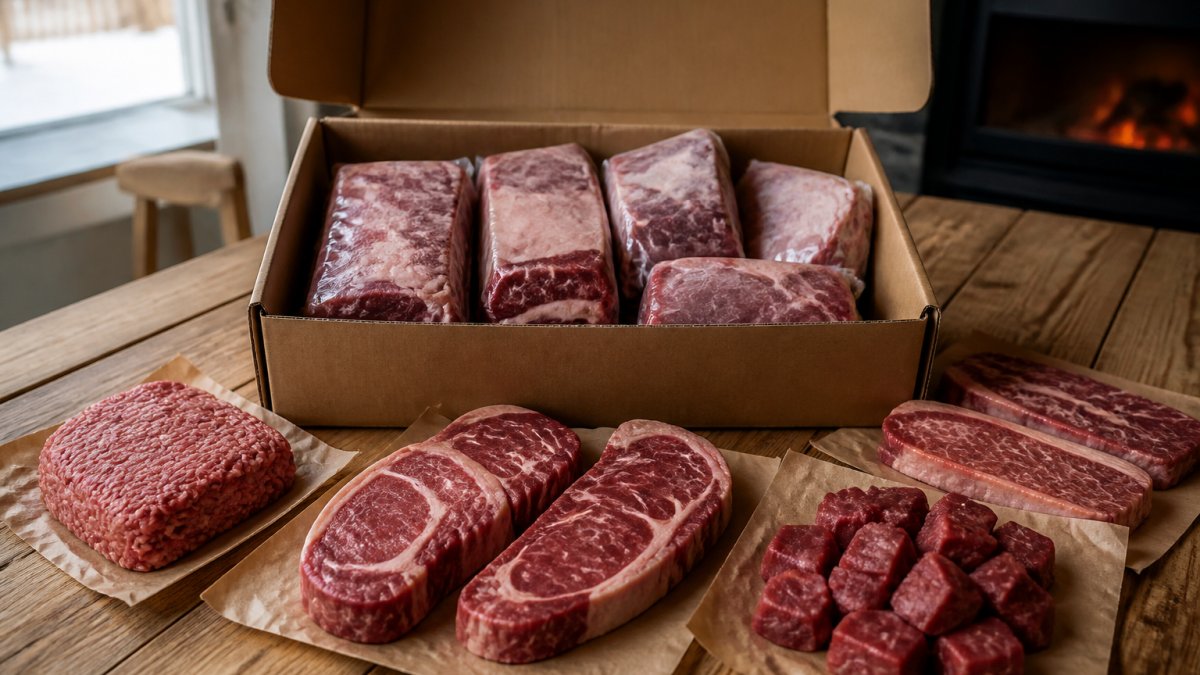
Individual cuts (steaks, roasts, ground beef) require no freezer space and no advance commitment. This option suits households buying occasional premium beef or testing a farm before committing to larger orders. Pricing depends on quantity, dates, and delivery; view products on our website for current prices.
Quarter beef purchases include a mixed selection of cuts, steaks, roasts, ground beef, and stewing meat, at a discounted rate of roughly $8-12 per pound hanging weight (the weight before trimming and processing). A quarter beef typically yields 40-50 pounds of finished, packaged meat and costs $320-600 depending on the farm and current cattle prices.
Half beef purchases offer the best per-pound value at $7-11 per pound hanging weight, yielding 80-100 pounds of finished meat for $560-1,100. A half beef requires 15-20 cubic feet of freezer space. Some farms charge processing fees separately (typically $0.50-1.00 per pound) on top of the hanging weight price; others include processing in their quoted price.
Delivery and Pickup Logistics
Most Alberta farms deliver on a fixed monthly or bi-weekly schedule, for example, the first Friday of each month or every second Thursday. Some offer flexible delivery windows (e.g., "any weekday between 9 a.m. and 5 p.m."); others require pickup at a central location or farm gate. Delivery areas typically extend 50-150 kilometres from the farm, depending on the operation.
Beef arrives frozen or well-chilled in insulated boxes with ice packs or dry ice. The cold chain is critical for food safety and quality. Inspect packaging when it arrives, it should feel solid and cold to the touch. If packaging is damaged, contents have thawed, or delivery took longer than expected, contact the farm immediately.
Pickup orders typically require 24-48 hours' notice and may be available at the farm, a farmers' market, or a central drop-off point in Calgary or Edmonton. Pickup eliminates delivery fees and gives you control over timing, but requires you to travel to the location.
Freezer Space and Storage Planning
Freezer space is the primary constraint for bulk purchases. A quarter beef, when cut into individual portions and packaged, occupies 8-12 cubic feet depending on how finely it's butchered. A half beef requires 15-20 cubic feet.
Before ordering, measure your available freezer space or check your freezer's capacity in the manual (usually listed in cubic feet). If space is tight, consider splitting a half or quarter beef with another family, purchasing only individual cuts, or staggering orders across two or three months.
Organize your freezer strategically to maximize space and usability. Vacuum-seal or double-wrap all packages to prevent freezer burn. Label everything with the cut name, weight, and date received using a permanent marker. Arrange packages so older purchases are accessible first, rotate stock so you use the oldest beef before the newest.
Thawing and Preparation
Thaw beef in the refrigerator, never at room temperature, to prevent bacterial growth. Plan ahead: a large roast (3-5 pounds) may take 24-48 hours to thaw completely. Ground beef and thin steaks thaw faster, typically in 12-24 hours. Once thawed, cook beef within 3-5 days or refreeze if you're not ready to use it.
Many farms provide cutting and packaging guidance when you place an order. Ask whether you can request specific cuts (e.g., extra steaks, minimal ground beef) or whether the butcher's selection is fixed. Some farms offer custom butchering for an additional fee, allowing you to tailor your quarter or half beef to your household's preferences.
Frequently Asked Questions
How can I verify that ethical beef is actually humanely raised and not just marketing?
Look for third-party certifications and ask farmers specific questions about their practices. Request details on herd size, pasture rotation, housing conditions, and whether they use antibiotics or hormones. Reputable producers welcome transparency and can provide documentation. Visit the farm if possible, or ask for photos and references from existing customers. Direct-to-consumer sellers like family farms are often more willing to share their full operation details than conventional suppliers.
What is the difference between grass-fed and grass-finished beef?
Grass-fed means cattle graze on pasture for at least part of their lives, but some producers may finish them on grain before slaughter. Grass-finished means cattle eat only grass and forage throughout their entire lives, never grain. Grass-finished beef typically has a different nutrient profile and flavor. When buying Alberta grass-fed beef, ask your farmer which method they use so you know exactly what you are purchasing.
Can I buy smaller quantities of beef if I have limited freezer space?
Yes. Many direct-to-consumer farms and local sellers offer customizable orders rather than fixed bulk packages. You can often request specific cuts, quantities, and delivery schedules that fit your household needs and freezer capacity. Contact your local producer to discuss options, or ask about sharing orders with friends or family to split larger quantities. Some farms also offer subscription models with flexible portion sizes.
What questions should I ask a beef farmer before buying?
Ask about their breeding practices, pasture management, use of medications or hormones, feed sources, animal welfare standards, and how long cattle spend on pasture. Request information on certifications, inspection records, and whether they practice rotational grazing. Ask about their slaughter and processing methods, cold chain handling, and customer references. Understand their pricing structure and what it includes. Trustworthy farmers will answer these questions directly and provide supporting documentation.
View Products
Comments